

What Is Ethnic Makeup What Does Ethnic Makeup Mean
An ethnic group or an ethnicity is a grouping of people who identify with each other on the footing of shared attributes that distinguish them from other groups. Those attributes can include mutual sets of traditions, beginnings, language, history, society, civilization, nation, religion, or social treatment inside their residing expanse.[1] [two] [3] Ethnicity is sometimes used interchangeably with the term nation, particularly in cases of indigenous nationalism, and is dissever from the related concept of races.
Ethnicity may be construed as an inherited or every bit a societally imposed construct. Ethnic membership tends to be defined by a shared cultural heritage, ancestry, origin myth, history, homeland, linguistic communication, or dialect, symbolic systems such equally religion, mythology and ritual, cuisine, dressing style, fine art, or physical appearance. Ethnic groups may share a narrow or broad spectrum of genetic ancestry, depending on group identification, with many groups having mixed genetic ancestry.[four] [five] [half-dozen] Indigenous groups often continue to speak related languages.
By style of linguistic communication shift, acculturation, adoption and religious conversion, individuals or groups may over time shift from one ethnic group to another. Ethnic groups may exist subdivided into subgroups or tribes, which over time may become carve up ethnic groups themselves due to endogamy or physical isolation from the parent group. Conversely, formerly dissever ethnicities can merge to course a pan-ethnicity and may eventually merge into one single ethnicity. Whether through division or affiliation, the formation of a separate ethnic identity is referred to as ethnogenesis.
Although both organic and performative criteria characterise ethnic groups, debate in the by had dichotomised between primordialism and constructivism. Before twentieth century 'Primordialists' viewed ethnic groups equally existent phenomena whose distinct characteristics accept endured since the distant past.[7] Perspectives which developed after 1960s increasingly viewed ethnic groups equally social constructs, with identity assigned by societal rules.[eight] [9]
Terminology [edit]
The term ethnic is derived from the Greek word ἔθνος ethnos (more precisely, from the adjective ἐθνικός ethnikos,[10] which was loaned into Latin every bit ethnicus). The inherited English linguistic communication term for this concept is folk, used aslope the latinate people since the tardily Middle English period.
In Early Modern English and until the mid-19th century, ethnic was used to mean heathen or pagan (in the sense of disparate "nations" which did non yet participate in the Christian oikumene), as the Septuagint used ta ethne ("the nations") to translate the Hebrew goyim "the nations, non-Hebrews, non-Jews".[11] The Greek term in early artifact (Homeric Greek) could refer to any big group, a host of men, a band of comrades as well as a swarm or flock of animals. In Classical Greek, the term took on a pregnant comparable to the concept now expressed past "ethnic group", by and large translated as "nation, people"; only in Hellenistic Greek did the term tend to get farther narrowed to refer to "foreign" or "barbarous" nations in particular (whence the later meaning "infidel, pagan").[12] In the 19th century, the term came to be used in the sense of "peculiar to a race, people or nation", in a return to the original Greek meaning. The sense of "different cultural groups", and in American English "racial, cultural or national minority group" arises in the 1930s to 1940s,[13] serving equally a replacement of the term race which had earlier taken this sense but was now becoming deprecated due to its clan with ideological racism. The abstruse ethnicity had been used for "paganism" in the 18th century, but now came to express the meaning of an "ethnic character" (first recorded 1953). The term ethnic group was first recorded in 1935 and entered the Oxford English Dictionary in 1972.[xiv] Depending on context, the term nationality may be used either synonymously with ethnicity or synonymously with citizenship (in a sovereign country). The process that results in emergence of an ethnicity is called ethnogenesis, a term in utilise in ethnological literature since about 1950. The term may besides be used with the connotation of something exotic (cf. "ethnic eating house", etc.), generally related to cultures of more recent immigrants, who arrived later on the ascendant population of an area was established.
Depending on which source of group identity is emphasized to define membership, the following types of (often mutually overlapping) groups tin exist identified:
- Ethno-linguistic, emphasizing shared linguistic communication, dialect (and possibly script) – example: French Canadians
- Ethno-national, emphasizing a shared polity or sense of national identity – case: Austrians
- Ethno-racial, emphasizing shared concrete appearance based on phenotype – case: African Americans
- Ethno-regional, emphasizing a singled-out local sense of belonging stemming from relative geographic isolation – example: S Islanders of New Zealand
- Ethno-religious, emphasizing shared affiliation with a particular religion, denomination or sect – case: Jews
- Ethno-cultural, emphasizing shared civilization or tradition, often overlapping with other forms of ethnicity – example: Travellers
In many cases, more than than one attribute determines membership: for instance, Armenian ethnicity can be divers by Armenian citizenship, native utilize of the Armenian language, or membership of the Armenian Apostolic Church.
Definitions and conceptual history [edit]
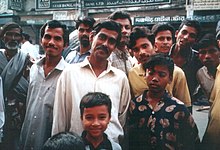
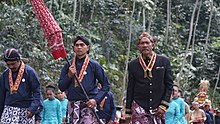
Ethnography begins in classical antiquity; after early authors like Anaximander and Hecataeus of Miletus, Herodotus laid the foundation of both historiography and ethnography of the ancient world c. 480 BC. The Greeks had developed a concept of their own "ethnicity", which they grouped under the name of Hellenes. Herodotus (8.144.2) gave a famous account of what divers Greek (Hellenic) ethnic identity in his mean solar day, enumerating
- shared descent (ὅμαιμον – homaimon, "of the same blood"),[16]
- shared language (ὁμόγλωσσον – homoglōsson, "speaking the aforementioned language"),[17]
- shared sanctuaries and sacrifices (Greek: θεῶν ἱδρύματά τε κοινὰ καὶ θυσίαι – theōn hidrumata te koina kai thusiai),[18]
- shared customs (Greek: ἤθεα ὁμότροπα – ēthea homotropa, "customs of like fashion").[19] [20] [21]
Whether ethnicity qualifies every bit a cultural universal is to some extent dependent on the exact definition used. Many social scientists,[22] such as anthropologists Fredrik Barth and Eric Wolf, practice non consider ethnic identity to be universal. They regard ethnicity as a product of specific kinds of inter-group interactions, rather than an essential quality inherent to homo groups.[23] [ irrelevant citation ]
According to Thomas Hylland Eriksen, the study of ethnicity was dominated past ii distinct debates until recently.
- One is between "primordialism" and "instrumentalism". In the primordialist view, the participant perceives ethnic ties collectively, equally an externally given, even coercive, social bond.[24] The instrumentalist arroyo, on the other hand, treats ethnicity primarily equally an ad hoc element of a political strategy, used every bit a resources for interest groups for achieving secondary goals such as, for case, an increase in wealth, power, or condition.[25] [26] This debate is still an important indicate of reference in Political science, although well-nigh scholars' approaches fall between the two poles.[27]
- The second contend is betwixt "constructivism" and "essentialism". Constructivists view national and indigenous identities as the production of historical forces, oftentimes recent, even when the identities are presented as old.[28] [29] Essentialists view such identities as ontological categories defining social actors.[30] [31]
According to Eriksen, these debates accept been superseded, specially in anthropology, past scholars' attempts to respond to increasingly politicized forms of self-representation by members of unlike ethnic groups and nations. This is in the context of debates over multiculturalism in countries, such as the U.s. and Canada, which accept large immigrant populations from many different cultures, and post-colonialism in the Caribbean and Southern asia.[32]
Max Weber maintained that ethnic groups were künstlich (artificial, i.due east. a social construct) because they were based on a subjective belief in shared Gemeinschaft (community). Secondly, this belief in shared Gemeinschaft did not create the group; the group created the belief. Third, group germination resulted from the drive to monopolize power and status. This was contrary to the prevailing naturalist belief of the time, which held that socio-cultural and behavioral differences between peoples stemmed from inherited traits and tendencies derived from common descent, then called "race".[33]
Another influential theoretician of ethnicity was Fredrik Barth, whose "Ethnic Groups and Boundaries" from 1969 has been described every bit instrumental in spreading the usage of the term in social studies in the 1980s and 1990s.[34] Barth went further than Weber in stressing the constructed nature of ethnicity. To Barth, ethnicity was perpetually negotiated and renegotiated past both external ascription and internal self-identification. Barth'southward view is that ethnic groups are not discontinuous cultural isolates or logical a priority to which people naturally belong. He wanted to part with anthropological notions of cultures as divisional entities, and ethnicity as primordialist bonds, replacing it with a focus on the interface betwixt groups. "Ethnic Groups and Boundaries", therefore, is a focus on the interconnectedness of ethnic identities. Barth writes: "...chiselled ethnic distinctions exercise not depend on an absence of mobility, contact, and information, but do entail social processes of exclusion and incorporation whereby detached categories are maintained despite irresolute participation and membership in the class of individual life histories."
In 1978, anthropologist Ronald Cohen claimed that the identification of "ethnic groups" in the usage of social scientists oft reflected inaccurate labels more than indigenous realities:
... the named indigenous identities we accept, frequently unthinkingly, every bit basic givens in the literature are oft arbitrarily, or fifty-fifty worse inaccurately, imposed.[34]
In this way, he pointed to the fact that identification of an ethnic grouping by outsiders, e.g. anthropologists, may not coincide with the self-identification of the members of that group. He besides described that in the get-go decades of usage, the term ethnicity had oft been used in lieu of older terms such every bit "cultural" or "tribal" when referring to smaller groups with shared cultural systems and shared heritage, but that "ethnicity" had the added value of beingness able to describe the commonalities between systems of grouping identity in both tribal and modern societies. Cohen also suggested that claims concerning "ethnic" identity (like earlier claims concerning "tribal" identity) are frequently colonialist practices and effects of the relations between colonized peoples and nation-states.[34]
According to Paul James, formations of identity were often changed and distorted past colonization, but identities are not made out of zero:
Categorizations about identity, even when codified and hardened into articulate typologies by processes of colonization, state formation or general modernizing processes, are always full of tensions and contradictions. Sometimes these contradictions are destructive, but they can likewise be creative and positive.[35]
Social scientists have thus focused on how, when, and why different markers of ethnic identity become salient. Thus, anthropologist Joan Vincent observed that ethnic boundaries oft have a mercurial grapheme.[36] Ronald Cohen ended that ethnicity is "a series of nesting dichotomizations of inclusiveness and exclusiveness".[34] He agrees with Joan Vincent's observation that (in Cohen's paraphrase) "Ethnicity... tin be narrowed or broadened in boundary terms in relation to the specific needs of political mobilization.[34] This may be why descent is sometimes a marker of ethnicity, and sometimes not: which diacritic of ethnicity is salient depends on whether people are scaling ethnic boundaries up or down, and whether they are scaling them up or downwardly depends mostly on the political situation.
Kanchan Chandra rejects the expansive definitions of indigenous identity (such equally those that include common culture, common linguistic communication, mutual history and common territory), choosing instead to ascertain indigenous identity narrowly as a subset of identity categories adamant past the belief of common descent.[37] Jóhanna Birnir similarly defines ethnicity as "group self-identification effectually a characteristic that is very hard or even impossible to alter, such as linguistic communication, race, or location."[38]
Approaches to understanding ethnicity [edit]
Different approaches to agreement ethnicity take been used past different social scientists when trying to empathize the nature of ethnicity as a factor in homo life and society. Equally Jonathan Thousand. Hall observes, Globe War II was a turning point in ethnic studies. The consequences of Nazi racism discouraged essentialist interpretations of indigenous groups and race. Ethnic groups came to be defined equally social rather than biological entities. Their coherence was attributed to shared myths, descent, kinship, a commonplace of origin, linguistic communication, religion, community, and national character. And so, ethnic groups are conceived equally mutable rather than stable, constructed in discursive practices rather than written in the genes.[39]
Examples of various approaches are primordialism, essentialism, perennialism, constructivism, modernism, and instrumentalism.
- "Primordialism", holds that ethnicity has existed at all times of human history and that mod ethnic groups have historical continuity into the far past. For them, the idea of ethnicity is closely linked to the idea of nations and is rooted in the pre-Weber agreement of humanity every bit being divided into primordially existing groups rooted past kinship and biological heritage.
- "Essentialist primordialism" further holds that ethnicity is an a priori fact of human being existence, that ethnicity precedes any human social interaction and that it is unchanged past information technology. This theory sees ethnic groups as natural, non simply every bit historical. It besides has problems dealing with the consequences of intermarriage, migration and colonization for the composition of modern-twenty-four hours multi-ethnic societies.[xl]
- "Kinship primordialism" holds that ethnic communities are extensions of kinship units, basically being derived by kinship or clan ties where the choices of cultural signs (language, religion, traditions) are made exactly to testify this biological analogousness. In this way, the myths of mutual biological ancestry that are a defining feature of indigenous communities are to exist understood equally representing actual biological history. A problem with this view on ethnicity is that it is generally the example that mythic origins of specific ethnic groups directly contradict the known biological history of an indigenous community.[40]
- "Geertz'due south primordialism", notably espoused by anthropologist Clifford Geertz, argues that humans in general attribute an overwhelming ability to primordial man "givens" such as blood ties, language, territory, and cultural differences. In Geertz' opinion, ethnicity is not in itself primordial but humans perceive it as such because it is embedded in their experience of the world.[40]
- "Perennialism", an arroyo that is primarily concerned with nationhood only tends to come across nations and ethnic communities every bit basically the same phenomenon holds that the nation, equally a blazon of social and political organization, is of an immemorial or "perennial" character.[41] Smith (1999) distinguishes two variants: "continuous perennialism", which claims that detail nations have existed for very long periods, and "recurrent perennialism", which focuses on the emergence, dissolution and reappearance of nations as a recurring aspect of human history.[42]
- "Perpetual perennialism" holds that specific ethnic groups take existed continuously throughout history.
- "Situational perennialism" holds that nations and indigenous groups emerge, alter and vanish through the course of history. This view holds that the concept of ethnicity is a tool used by political groups to manipulate resource such as wealth, power, territory or status in their item groups' interests. Appropriately, ethnicity emerges when it is relevant equally a means of furthering emergent commonage interests and changes according to political changes in society. Examples of a perennialist estimation of ethnicity are also institute in Barth and Seidner who run across ethnicity as ever-changing boundaries between groups of people established through ongoing social negotiation and interaction.
- "Instrumentalist perennialism", while seeing ethnicity primarily as a versatile tool that identified different ethnics groups and limits through fourth dimension, explains ethnicity every bit a mechanism of social stratification, meaning that ethnicity is the ground for a hierarchical arrangement of individuals. According to Donald Noel, a sociologist who adult a theory on the origin of ethnic stratification, indigenous stratification is a "system of stratification wherein some relatively fixed group membership (east.g., race, religion, or nationality) is utilized as a major criterion for assigning social positions".[43] Indigenous stratification is one of many unlike types of social stratification, including stratification based on socio-economical status, race, or gender. According to Donald Noel, ethnic stratification will sally only when specific indigenous groups are brought into contact with one another, and only when those groups are characterized by a high degree of ethnocentrism, contest, and differential power. Ethnocentrism is the tendency to look at the globe primarily from the perspective of one's own culture, and to downgrade all other groups outside ane'due south own culture. Some sociologists, such as Lawrence Bobo and Vincent Hutchings, say the origin of ethnic stratification lies in individual dispositions of ethnic prejudice, which relates to the theory of ethnocentrism.[44] Standing with Noel's theory, some degree of differential power must be present for the emergence of ethnic stratification. In other words, an inequality of power among ethnic groups ways "they are of such unequal power that ane is able to impose its will upon another".[43] In addition to differential power, a degree of contest structured along ethnic lines is a prerequisite to indigenous stratification as well. The different ethnic groups must be competing for some common goal, such every bit power or influence, or a material interest, such equally wealth or territory. Lawrence Bobo and Vincent Hutchings propose that competition is driven by self-interest and hostility, and results in inevitable stratification and conflict.[44]
- "Constructivism" sees both primordialist and perennialist views as basically flawed,[44] and rejects the notion of ethnicity as a bones human being condition. It holds that indigenous groups are simply products of homo social interaction, maintained only in so far equally they are maintained as valid social constructs in societies.
- "Modernist constructivism" correlates the emergence of ethnicity with the move towards nation states beginning in the early modern menses.[45] Proponents of this theory, such as Eric Hobsbawm, argue that ethnicity and notions of indigenous pride, such as nationalism, are purely mod inventions, appearing simply in the mod period of earth history. They agree that prior to this ethnic homogeneity was not considered an ideal or necessary factor in the forging of large-scale societies.
Ethnicity is an important means past which people may place with a larger group. Many social scientists, such as anthropologists Fredrik Barth and Eric Wolf, do not consider ethnic identity to exist universal. They regard ethnicity as a product of specific kinds of inter-group interactions, rather than an essential quality inherent to homo groups.[23] The process that results in emergence of such identification is chosen ethnogenesis. Members of an indigenous group, on the whole, claim cultural continuities over time, although historians and cultural anthropologists take documented that many of the values, practices, and norms that imply continuity with the by are of relatively contempo invention.[46] [47]
Ethnic groups can form a cultural mosaic in a gild. That could exist in a city similar New York City or Trieste, only also the fallen monarchy of the Austria-hungary or the United States. Current topics are in particular social and cultural differentiation, multilingualism, competing identity offers, multiple cultural identities and the formation of Salad bowl and melting pot.[48] [49] [l] [51] Indigenous groups differ from other social groups, such equally subcultures, interest groups or social classes, considering they emerge and change over historical periods (centuries) in a process known as ethnogenesis, a period of several generations of endogamy resulting in common ancestry (which is and so sometimes bandage in terms of a mythological narrative of a founding effigy); ethnic identity is reinforced by reference to "boundary markers" – characteristics said to be unique to the group which set information technology autonomously from other groups.[52] [53] [54] [55] [56] [57]
Ethnicity theory in the United States [edit]
Ethnicity theory argues that race is a social category and is only one of several factors in determining ethnicity. Other criteria include "religion, language, 'customs', nationality, and political identification".[58] This theory was put frontwards by sociologist Robert E. Park in the 1920s. It is based on the notion of "culture".
This theory was preceded past more than 100 years during which biological essentialism was the ascendant prototype on race. Biological essentialism is the belief that some races, specifically white Europeans in western versions of the paradigm, are biologically superior and other races, specifically not-white races in western debates, are inherently inferior. This view arose every bit a style to justify enslavement of African Americans and genocide of Native Americans in a order that was officially founded on liberty for all. This was a notion that adult slowly and came to be a preoccupation with scientists, theologians, and the public. Religious institutions asked questions about whether there had been multiple creations of races (polygenesis) and whether God had created lesser races. Many of the foremost scientists of the time took up the idea of racial departure and institute that white Europeans were superior.[59]
The ethnicity theory was based on the absorption model. Park outlined four steps to absorption: contact, disharmonize, accommodation, and assimilation. Instead of attributing the marginalized status of people of colour in the U.s. to their inherent biological inferiority, he attributed it to their failure to assimilate into American civilisation. They could become equal if they abandoned their inferior cultures.
Michael Omi and Howard Winant'southward theory of racial formation directly confronts both the premises and the practices of ethnicity theory. They argue in Racial Formation in the U.s. that the ethnicity theory was exclusively based on the immigration patterns of the white population and did take into business relationship the unique experiences of non-whites in the United States.[60] While Park's theory identified different stages in the clearing process – contact, conflict, struggle, and every bit the terminal and all-time response, assimilation – information technology did and so only for white communities.[sixty] The ethnicity paradigm neglected the ways in which race can complicate a community's interactions with social and political structures, especially upon contact.
Absorption – shedding the particular qualities of a native culture for the purpose of blending in with a host culture – did not work for some groups as a response to racism and discrimination, though information technology did for others.[threescore] Once the legal barriers to achieving equality had been dismantled, the trouble of racism became the sole responsibility of already disadvantaged communities.[61] It was assumed that if a Blackness or Latino community was non "making it" by the standards that had been set past whites, it was considering that community did not concur the right values or beliefs, or were stubbornly resisting dominant norms because they did not want to fit in. Omi and Winant's critique of ethnicity theory explains how looking to cultural defect equally the source of inequality ignores the "concrete sociopolitical dynamics within which racial phenomena operate in the U.S."[62] It prevents disquisitional test of the structural components of racism and encourages a "benign fail" of social inequality.[62]
Ethnicity and nationality [edit]
In some cases, especially involving transnational migration or colonial expansion, ethnicity is linked to nationality. Anthropologists and historians, post-obit the modernist understanding of ethnicity as proposed past Ernest Gellner[63] and Bridegroom Anderson[64] see nations and nationalism every bit developing with the ascension of the modern state system in the 17th century. They culminated in the rising of "nation-states" in which the presumptive boundaries of the nation coincided (or ideally coincided) with land boundaries. Thus, in the West, the notion of ethnicity, similar race and nation, developed in the context of European colonial expansion, when mercantilism and capitalism were promoting global movements of populations at the same time state boundaries were being more conspicuously and rigidly defined.
In the 19th century, modern states more often than not sought legitimacy through their claim to represent "nations". Nation-states, however, invariably include populations who have been excluded from national life for one reason or another. Members of excluded groups, consequently, volition either demand inclusion based on equality or seek autonomy, sometimes even to the extent of complete political separation in their nation-state.[65] Under these conditionswhen people moved from i state to another,[66] or 1 state conquered or colonized peoples beyond its national boundaries – ethnic groups were formed by people who identified with one nation, but lived in another state.
Multi-ethnic states can be the effect of two contrary events, either the recent creation of state borders at variance with traditional tribal territories, or the recent immigration of indigenous minorities into a former nation-state. Examples for the first case are institute throughout Africa, where countries created during decolonization inherited capricious colonial borders, but also in European countries such as Belgium or United Kingdom. Examples for the 2d case are countries such as Netherlands, which were relatively ethnically homogeneous when they attained statehood only accept received significant immigration in the 17th century and even more then in the second one-half of the 20th century. States such as the United kingdom of great britain and northern ireland, France and Switzerland comprised distinct ethnic groups from their formation and have likewise experienced substantial immigration, resulting in what has been termed "multicultural" societies, peculiarly in large cities.
The states of the New World were multi-indigenous from the onset, as they were formed as colonies imposed on existing indigenous populations.
In recent decades feminist scholars (almost notably Nira Yuval-Davis)[67] have drawn attention to the fundamental ways in which women participate in the creation and reproduction of indigenous and national categories. Though these categories are usually discussed every bit belonging to the public, political sphere, they are upheld inside the private, family sphere to a great extent.[68] Information technology is here that women act not just every bit biological reproducers but also as "cultural carriers", transmitting knowledge and enforcing behaviors that belong to a specific collectivity.[69] Women also often play a significant symbolic function in conceptions of nation or ethnicity, for example in the notion that "women and children" constitute the kernel of a nation which must be defended in times of conflict, or in iconic figures such as Britannia or Marianne.
Ethnicity and race [edit]
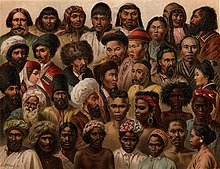
Ethnicity is used every bit a affair of cultural identity of a group, often based on shared ancestry, language, and cultural traditions, while race is practical as a taxonomic group, based on physical similarities amid groups. Race is a more than controversial discipline than ethnicity, due to common political use of the term. Ramón Grosfoguel (University of California, Berkeley) argues that "racial/indigenous identity" is ane concept and concepts of race and ethnicity cannot be used as carve up and democratic categories.[70]
Earlier Weber (1864–1920), race and ethnicity were primarily seen every bit two aspects of the same thing. Effectually 1900 and before, the primordialist understanding of ethnicity predominated: cultural differences between peoples were seen as being the upshot of inherited traits and tendencies.[71] With Weber's introduction of the idea of ethnicity as a social construct, race and ethnicity became more divided from each other.
In 1950, the UNESCO statement "The Race Question", signed past some of the internationally renowned scholars of the time (including Ashley Montagu, Claude Lévi-Strauss, Gunnar Myrdal, Julian Huxley, etc.), said:
National, religious, geographic, linguistic and cultural groups practice not necessarily coincide with racial groups: and the cultural traits of such groups have no demonstrated genetic connectedness with racial traits. Because serious errors of this kind are habitually committed when the term "race" is used in popular parlance, it would be better when speaking of human races to drop the term "race" birthday and speak of "ethnic groups".[72]
In 1982, anthropologist David Craig Griffith summed up forty years of ethnographic research, arguing that racial and ethnic categories are symbolic markers for different ways people from different parts of the world have been incorporated into a global economy:
The opposing interests that divide the working classes are further reinforced through appeals to "racial" and "ethnic" distinctions. Such appeals serve to classify different categories of workers to rungs on the scale of labor markets, relegating stigmatized populations to the lower levels and insulating the higher echelons from competition from below. Capitalism did not create all the distinctions of ethnicity and race that function to set off categories of workers from 1 another. It is, nevertheless, the procedure of labor mobilization nether capitalism that imparts to these distinctions their constructive values.[73]
According to Wolf, racial categories were constructed and incorporated during the menstruum of European mercantile expansion, and indigenous groupings during the period of capitalist expansion.[74]
Writing in 1977 about the usage of the term "ethnic" in the ordinary linguistic communication of Great Britain and the United States, Wallman noted
The term "ethnic" popularly connotes "[race]" in Britain, only less precisely, and with a lighter value load. In North America, by dissimilarity, "[race]" most unremarkably means color, and "ethnics" are the descendants of relatively contempo immigrants from non-English-speaking countries. "[Indigenous]" is not a noun in United kingdom of great britain and northern ireland. In effect there are no "ethnics"; there are simply "ethnic relations".[75]
In the U.S., the OMB says the definition of race as used for the purposes of the US Census is not "scientific or anthropological" and takes into account "social and cultural characteristics as well as ancestry", using "advisable scientific methodologies" that are not "primarily biological or genetic in reference".[76]
Ethno-national disharmonize [edit]
Sometimes indigenous groups are subject to prejudicial attitudes and deportment by the state or its constituents. In the 20th century, people began to argue that conflicts among ethnic groups or between members of an indigenous group and the state can and should be resolved in one of two means. Some, similar Jürgen Habermas and Bruce Barry, have argued that the legitimacy of modern states must exist based on a notion of political rights of autonomous individual subjects. According to this view, the state should not admit indigenous, national or racial identity but rather instead enforce political and legal equality of all individuals. Others, like Charles Taylor and Will Kymlicka, argue that the notion of the autonomous individual is itself a cultural construct. Co-ordinate to this view, states must recognize ethnic identity and develop processes through which the particular needs of ethnic groups can be accommodated within the boundaries of the nation-state.
The 19th century saw the development of the political ideology of ethnic nationalism, when the concept of race was tied to nationalism, first past German theorists including Johann Gottfried von Herder. Instances of societies focusing on ethnic ties, arguably to the exclusion of history or historical context, accept resulted in the justification of nationalist goals. Ii periods often cited every bit examples of this are the 19th-century consolidation and expansion of the German Empire and the 20th century Nazi Deutschland. Each promoted the pan-indigenous thought that these governments were acquiring only lands that had always been inhabited by indigenous Germans. The history of tardily-comers to the nation-state model, such every bit those arising in the Near East and south-eastern Europe out of the dissolution of the Ottoman and Austro-Hungarian Empires, as well as those arising out of the onetime USSR, is marked by inter-ethnic conflicts. Such conflicts usually occur inside multi-ethnic states, as opposed to between them, as in other regions of the world. Thus, the conflicts are often misleadingly labeled and characterized as civil wars when they are inter-ethnic conflicts in a multi-ethnic land.
Ethnic groups by continent [edit]
Africa [edit]
Indigenous groups in Africa number in the hundreds, each generally having its own linguistic communication (or dialect of a language) and culture.
Asia [edit]
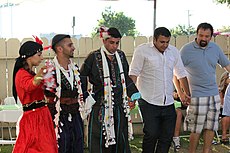
Ethnic groups are abundant throughout Asia, with adaptations to the climate zones of Asia, which can be the Arctic, subarctic, temperate, subtropical or tropical. The ethnic groups have adjusted to mountains, deserts, grasslands, and forests.
On the coasts of Asia, the ethnic groups have adopted various methods of harvest and send. Some groups are primarily hunter-gatherers, some practice transhumance (nomadic lifestyle), others have been agrarian/rural for millennia and others becoming industrial/urban. Some groups/countries of Asia are completely urban, such as those in Hong Kong, Shanghai, and Singapore. The colonization of Asia was largely ended in the 20th century, with national drives for independence and self-determination across the continent.
In Indonesia alone, at that place are more than one,300 ethnic groups recognized by the government, which are located on 17,000 islands in the Indonesian archipelago
Russia has more than 185 recognized ethnic groups besides the 80 percent ethnic Russian bulk. The largest group is the Tatars, iii.eight percent. Many of the smaller groups are institute in the Asian part of Russian federation (see Ethnic peoples of Siberia).
Europe [edit]
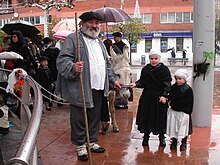
The Basque people constitute an indigenous indigenous minority in both France and Espana.
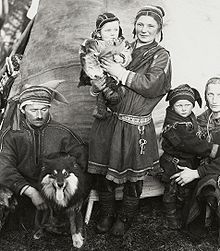

The Irish are an ethnic group indigenous to Ireland of which 70–80 million people worldwide claim ancestry.[77]
Europe has a big number of ethnic groups; Pan and Pfeil (2004) count 87 distinct "peoples of Europe", of which 33 class the majority population in at least one sovereign state, while the remaining 54 plant indigenous minorities inside every state they inhabit (although they may form local regional majorities within a sub-national entity). The total number of national minority populations in Europe is estimated at 105 one thousand thousand people or fourteen% of 770 million Europeans.[78]
A number of European countries, including French republic[79] and Switzerland, do not collect information on the ethnicity of their resident population.
An instance of a largely nomadic ethnic group in Europe is the Roma, pejoratively known every bit Gypsies. They originated from India and speak the Romani linguistic communication.
The Serbian province of Vojvodina is recognizable for its multi-indigenous and multi-cultural identity.[80] [81] There are some 26 ethnic groups in the province,[82] and 6 languages are in official use past the provincial administration.[83]
North America [edit]
The indigenous people in North America are Native Americans. During European colonization, Europeans arrived in N America. Most Native Americans died due to Castilian diseases and other European diseases such as smallpox during the European colonization of the Americas. The largest ethnic group in the United States is White Americans. Hispanic and Latino Americans (Mexican Americans in detail) and Asian Americans accept immigrated to the United States recently. In Mexico, virtually Mexicans are mestizo, a mixture of Castilian and Native American ancestry. Some Hispanic and Latino Americans living in the Usa are not mestizos.[ citation needed ]
African slaves were brought to N America from the 16th to 19th centuries during the Atlantic slave trade. Many of them were sent to the Caribbean. Indigenous group that live in the Caribbean are Ethnic peoples, Africans, Indians, white Europeans, the Chinese and the Portuguese. The first white Europeans to arrive in the Dominican Democracy were the Spanish in 1492. The Caribbean area was likewise colonized and discovered by the Portuguese, English language, Dutch and French.[84]
A sizeable corporeality of people in the United states of america have mixed-race identities. In 2021, the number of Americans who identified every bit not-Hispanic and more than 1 race was 13.5 meg. The number of Hispanic Americans who identified as multiracial was 20.iii million.[85] Over the course of the 2010s decade, in that location was a 127% increase in non-Hispanic Americans who identified as multiracial.[85]
The largest ethnic groups in the United States are Germans, African Americans, Mexicans, Irish, English, Italians, Poles, French, Scottish, Native Americans, Puerto Ricans, Norwegians, Dutch people, Swedish people, Chinese people, Due west Indians, Russians and Filipinos.[86]
In Canada, European Canadians are the largest ethnic grouping. In Canada, the indigenous population is growing faster than the non-indigenous population. Most immigrants in Canada come from Asia.[87]
South America [edit]
In Southward America, almost people are mixed-race (generally mulatto and mestizo), indigenous and European (especially of Spanish or Portuguese ancestry).
Oceania [edit]
Near all states in Oceania take majority indigenous populations, with notable exceptions existence Australia, New Zealand and Norfolk Isle, who accept majority European populations.[88] States with smaller European populations include Guam, Hawaii and New Caledonia (whose Europeans are known as Caldoche).[89] [xc] Indigenous peoples of Oceania are Australian Aboriginals, Austronesians and Papuans, and they originated from Asia.[91] The Austronesians of Oceania are further broken up into three singled-out groups; Melanesians, Micronesians and Polynesians.
Oceanic Pacific islands nearing Latin America were uninhabited when discovered by Europeans in the 16th century, with zilch to indicate prehistoric human being activeness past Indigenous Americans or Indigenous Oceanians.[92] [93] [94] Contemporary residents are mainly mestizos and Europeans from the Latin American countries whom administrate them,[95] [96] although none of these islands have extensive populations.[97] Easter Isle are the only oceanic island politically associated with Latin America to have an ethnic population, the Polynesian Rapa Nui people.[98] Their current inhabitants include indigenous Polynesians and mestizo settlers from political administrators Republic of chile, in add-on to mixed-race individuals with Polynesian and mestizo/European ancestry.[98] The British overseas territory of Pitcairn Islands, to the west of Easter Isle, have a population of approximately 50 people. They are mixed-race Euronesians who descended from an initial group of British and Tahitian settlers in the 18th century. The islands were previously inhabited by Polynesians; they had long abased Pitcairn by the time the settlers had arrived.[99] Norfolk Isle, at present an external territory of Australia, is also believed to have been inhabited by Polynesians prior to its initial European discovery in the 18th century. Some of their residents are descended from mixed-race Pitcairn Islanders that were relocated onto Norfolk due to overpopulation in 1856.[100]
The once uninhabited Bonin Islands, subsequently politically integrated into Nihon, have a pocket-size population consisting of Japanese mainlanders and descendants of early on European settlers.[98] Archeological findings from the 1990s suggested there was possible prehistoric man activity past Micronesians prior to European discovery in the 16th century.[101]
Several political entities associated with Oceania are still uninhabited, including Baker Island, Clipperton Island, Howland Island and Jarvis Isle.[102] [103] There were brief attempts to settle Clipperton with Mexicans and Jarvis with Native Hawaiians in the early on 20th century. The Jarvis settlers were relocated from the isle due to Japanese advancements during World War II, while nigh of the settlers on Clipperton ended up dying from starvation and murdering i and other.[104] [102]
Commonwealth of australia [edit]
The starting time evident ethnic group to live in Australia were the Australian Aboriginals, a group considered related to the Melanesian Torres Strait Islander people. Europeans, primarily from England arrived offset in 1770.
The 2016 Census shows England and New Zealand are the next most common countries of nascence after Commonwealth of australia, the proportion of people built-in in Communist china and India has increased since 2011 (from half-dozen.0 per cent to viii.3 per cent, and 5.6 per cent to seven.four per cent, respectively).
The proportion of people identifying every bit being of Aboriginal or Torres Strait Islander origin increased from 2.5 per cent of the Australian population in 2011 to ii.viii per cent in 2016.
Run across also [edit]
- Ancestor
- Clan
- Diaspora
- Ethnic cleansing
- Ethnic flag
- Indigenous nationalism
- Ethnic penalisation
- Ethnocentrism
- Ethnocultural empathy
- Ethnogenesis
- Ethnocide
- Ethnographic grouping
- Genealogy
- Genetic genealogy
- Homeland
- Human Genome Multifariousness Projection
- Identity politics
- Ingroups and outgroups
- Intersectionality
- Kinship
- List of contemporary ethnic groups
- List of indigenous peoples
- Meta-ethnicity
- Minority grouping
- Multiculturalism
- Nation
- National symbol
- Passing (sociology)
- Polyethnicity
- Population genetics
- Race (homo categorization)
- Race and ethnicity in censuses
- Race and ethnicity in the United States Census
- Race and health
- Segmentary lineage
- Stateless nation
- Tribe
- Y-chromosome haplogroups in populations of the globe
References [edit]
- ^ Chandra, Kanchan (2012). Constructivist theories of ethnic politics. Oxford Academy Printing. pp. 69–70. ISBN978-0-19-989315-7. OCLC 829678440.
- ^ "ethnicity: definition of ethnicity". Oxford Dictionaries. Oxford University Press. Retrieved 28 December 2013.
- ^ People, James; Bailey, Garrick (2010). Humanity: An Introduction to Cultural Anthropology (9th ed.). Wadsworth Cengage learning. p. 389.
In essence, an ethnic group is a named social category of people based on perceptions of shared social feel or one's ancestors' experiences. Members of the ethnic group come across themselves as sharing cultural traditions and history that distinguish them from other groups. Ethnic group identity has a stiff psychological or emotional component that divides the people of the globe into opposing categories of 'us' and 'them'. In contrast to social stratification, which divides and unifies people along a series of horizontal axes based on socioeconomic factors, indigenous identities split up and unify people along a serial of vertical axes. Thus, ethnic groups, at least theoretically, cutting across socioeconomic class differences, drawing members from all strata of the population.
- ^ "Insight into Indigenous Differences". National Institutes of Health (NIH). 2015-05-25. Retrieved 2021-08-02 .
- ^ Banda, Yambazi; Kvale, Mark N.; Hoffmann, Thomas J.; Hesselson, Stephanie E.; Ranatunga, Dilrini; Tang, Hua; Sabatti, Chiara; Croen, Lisa A.; Dispensa, Brad P.; Henderson, Mary; Iribarren, Carlos (2015-08-01). "Characterizing Race/Ethnicity and Genetic Ancestry for 100,000 Subjects in the Genetic Epidemiology Research on Adult Wellness and Aging (GERA) Cohort". Genetics. 200 (four): 1285–1295. doi:10.1534/genetics.115.178616. ISSN 0016-6731. PMC4574246. PMID 26092716.
- ^ Salter, Frank; Harpending, Henry (2013-07-01). "J.P. Rushton's theory of ethnic nepotism". Personality and Individual Differences. 55 (3): 256–260. doi:10.1016/j.paid.2012.11.014. ISSN 0191-8869.
- ^ Bayar, Murat (2009-10-14). "Reconsidering primordialism: an alternative approach to the report of ethnicity". Ethnic and Racial Studies. 32 (9): 1639–1657. doi:10.1080/01419870902763878. S2CID 143391013.
- ^ Angela Onwuachi-Willig (6 September 2016). "Race and Racial Identity Are Social Constructs". The New York Times.
- ^ Chandra Ford; Nina T Harawa (29 April 2010). "A new conceptualization of ethnicity for social epidemiologic and health equity enquiry". Soc Sci Med. 71 (2): 251–258. doi:10.1016/j.socscimed.2010.04.008. PMC2908006. PMID 20488602.
- ^ ἐθνικός, Henry George Liddell, Robert Scott, A Greek-English Lexicon, on Perseus
- ^ ThiE. Tonkin, M. McDonald and G. Chapman, History and Ethnicity (London 1989), pp. 11–17 (quoted in J. Hutchinson & A.D. Smith (eds.), Oxford readers: Ethnicity (Oxford 1996), pp. 18–24)
- ^ ἔθνος, Henry George Liddell, Robert Scott, A Greek-English language Lexicon, on Perseus
- ^ Oxford English Lexicon Second edition, online version every bit of 2008-01-12, "ethnic, a. and n.". Cites Sir Daniel Wilson, The archaeology and prehistoric annals of Scotland 1851 (1863) and Huxley & Haddon (1935), Nosotros Europeans, pp. 136,181
- ^ Cohen, Ronald. (1978) "Ethnicity: Problem and Focus in Anthropology", Annu. Rev. Anthropol. 1978. 7:379–403; Glazer, Nathan and Daniel P. Moynihan (1975) Ethnicity – Theory and Experience, Cambridge, Massachusetts Harvard University Press. The modern usage definition of the Oxford English Dictionary is:
a[djective]
- ...
- 2.a. About race; peculiar to a race or nation; ethnological. Also, most or having common racial, cultural, religious, or linguistic characteristics, esp. designating a racial or other group within a larger system; hence (U.S. colloq.), strange, exotic.
- b indigenous minority (group), a group of people differentiated from the remainder of the community past racial origins or cultural background, and usu. challenge or enjoying official recognition of their group identity. Also attrib.
due north[oun]
- ...
- 3 A member of an ethnic grouping or minority. Equatorians
(Oxford English language Dictionary Second edition, online version equally of 2008-01-12, s.5. "ethnic, a. and northward.")
- ^ roughly 300 one thousand thousand worldwide (CIA Factbook 2014 estimates, numbers bailiwick to rapid population growth).
- ^ ὅμαιμος, Henry George Liddell, Robert Scott, A Greek-English language Lexicon, on Perseus
- ^ ὁμόγλωσσος, Henry George Liddell, Robert Scott, A Greek-English Lexicon, on Perseus
- ^ I. Polinskaya, "Shared sanctuaries and the gods of others: On the pregnant Of 'common' in Herodotus eight.144", in R. Rosen & I. Sluiter (eds.), Valuing others in Classical Antiquity (Leiden: Brill, 2010), 43–seventy.
- ^ ὁμότροπος, Henry George Liddell, Robert Scott, A Greek-English Dictionary, on Perseus)
- ^ Herodotus, viii.144.2: "The kinship of all Greeks in blood and speech, and the shrines of gods and the sacrifices that we have in common, and the likeness of our way of life."
- ^ Athena Southward. Leoussi, Steven Grosby, Nationalism and Ethnosymbolism: History, Civilisation, and Ethnicity in the Formation of Nations, Edinburgh Academy Press, 2006, p. 115
- ^ "Challenges of measuring an ethnic world". Publications.gc.ca. The Authorities of Canada. April 1, 1992.
Ethnicity is a fundamental factor in human life: it is a phenomenon inherent in human experience.
- ^ a b Fredrik Barth, ed. 1969 Ethnic Groups and Boundaries: The Social System of Cultural Departure; Eric Wolf 1982 Europe and the People Without History p. 381
- ^ Geertz, Clifford, ed. (1967) Former Societies and New States: The Quest for Modernity in Africa and Asia. New York: The Complimentary Printing.
- ^ Cohen, Abner (1969) Custom and Politics in Urban Africa: A Study of Hausa Migrants in a Yoruba Boondocks. London: Routledge & Kegan Paul.
- ^ Abner Cohen (1974) Two-Dimensional Man: An essay on power and symbolism in complex society. London: Routledge & Kegan Paul.
- ^ J. Hutchinson & A.D. Smith (eds.), Oxford readers: Ethnicity (Oxford 1996), "Introduction", 8–9
- ^ Gellner, Ernest (1983) Nations and Nationalism. Oxford: Blackwell.
- ^ Ernest Gellner (1997) Nationalism. London: Weidenfeld & Nicolson.
- ^ Smith, Anthony D. (1986) The Ethnic Origins of Nations. Oxford: Blackwell.
- ^ Anthony Smith (1991) National Identity. Harmondsworth: Penguin.
- ^ T.H. Eriksen "Ethnic identity, national identity and intergroup disharmonize: The significance of personal experiences" in Ashmore, Jussim, Wilder (eds.): Social identity, intergroup conflict, and conflict reduction, pp. 42–70. Oxford: Oxford University Press. 2001
- ^ Banton, Michael. (2007) "Weber on Indigenous Communities: A critique", Nations and Nationalism 13 (ane), 2007, 19–35.
- ^ a b c d e Ronald Cohen 1978 "Ethnicity: Problem and Focus in Anthropology", Annual Review of Anthropology seven: 383–384 Palo Alto: Stanford University Press
- ^ James, Paul (2015). "Despite the Terrors of Typologies: The Importance of Understanding Categories of Difference and Identity". Interventions: International Journal of Postcolonial Studies. 17 (2): 174–195. doi:x.1080/1369801X.2014.993332. S2CID 142378403.
- ^ Vincent, Joan (1974), "The Structure of Ethnicity" in Homo Organization 33(four): 375–379
- ^ Chandra, Kanchan (2006). "What is Indigenous Identity and Does it Matter?". Annual Review of Political Science. 9 (1): 397–424. doi:10.1146/annurev.polisci.9.062404.170715. ISSN 1094-2939.
- ^ Birnir, Jóhanna Kristín (2006). Ethnicity and Electoral Politics. Cambridge Academy Printing. p. 66. ISBN978-1-139-46260-0.
- ^ "David Konstan, "Defining Ancient Greek Ethnicity", Diaspora: A Periodical of Transnational Studies, vol. 6, 1 (1997), pp. 97–98. Overview of J.1000. Hall'southward book "Ethnic Identity in Greek Antiquity", Cambridge University Press, 1997" (PDF).
- ^ a b c (Smith 1999, p. 13)
- ^ Smith (1998), 159.
- ^ Smith (1999), 5.
- ^ a b Noel, Donald 50. (1968). "A Theory of the Origin of Ethnic Stratification". Social Bug. sixteen (2): 157–172. doi:10.1525/sp.1968.16.2.03a00030.
- ^ a b c Bobo, Lawrence; Hutchings, Vincent L. (1996). "Perceptions of Racial Grouping Competition: Extending Blumer's Theory of Group Position to a Multiracial Social Context". American Sociological Review. American Sociological Clan. 61 (vi): 951–972. doi:10.2307/2096302. JSTOR 2096302.
- ^ (Smith 1999, pp. 4–7)
- ^ Hobsbawm and Ranger (1983), The Invention of Tradition
- ^ Sider 1993 Lumbee Indian Histories.
- ^ Kolb, Eva (2009). The Evolution of New York City'due south Multiculturalism: Melting Pot or Salad Basin. ISBN9783837093032.
- ^ Levine, Randy; Serbeh-Dunn, Gifty (Leap 1999). "Mosaic vs. Melting Pot". Voices. Vol. 1, no. iv.
- ^ Pieter Grand. Judson "The Habsburg Empire. A New History" (Harvard 2016)
- ^ Patricia Engelhorn "Wie Wien mit Meersicht: Ein Tag in der Hafenstadt Triest" In: NZZ 15.2.2020; Roberto Scarciglia Trieste multiculturale: comunità eastward linguaggi di integrazione (2011); Ibanez B. Penas, Ma. Carmen López Sáenz. "Interculturalism: Between Identity and Variety". (Bern) 2006. p xv.
- ^ Camoroff, John L. and Jean Camoroff 2009: Ethnicity Inc. Chicago: Chicago Press.
- ^ The Invention of Tradition
- ^ Sider 1993 Lumbee Indian Histories
- ^ O'Neil, Dennis. "Nature of Ethnicity". Palomar College. Retrieved 7 January 2013.
- ^ Seidner,(1982), Ethnicity, Language, and Power from a Psycholinguistic Perspective, pp. 2–3
- ^ Smith 1987 pp. 21–22
- ^ Omi & Winant 1986, p. 15
- ^ Omi & Winant 1986, p. 58
- ^ a b c Omi & Winant 1986, p. 17
- ^ Omi & Winant 1986, p. nineteen
- ^ a b Omi & Winant 1986, p. 21
- ^ Gellner 2006 Nations and Nationalism Blackwell Publishing
- ^ Anderson 2006 Imagined Communities Version
- ^ Walter Pohl, "Conceptions of Ethnicity in Early Medieval Studies", Debating the Center Ages: Bug and Readings, ed. Lester K. Little and Barbara H. Rosenwein, (Blackwell), 1998, pp xiii–24, notes that historians accept projected the 19th-century conceptions of the nation-state astern in time, employing biological metaphors of birth and growth: "that the peoples in the Migration Menses had little to do with those heroic (or sometimes hardhearted) clichés is now mostly accustomed amongst historians," he remarked. Early medieval peoples were far less homogeneous than often thought, and Pohl follows Reinhard Wenskus, Stammesbildung und Verfassung. (Cologne and Graz) 1961, whose researches into the "ethnogenesis" of the German peoples convinced him that the idea of mutual origin, as expressed by Isidore of Seville Gens est multitudo ab uno principio orta ("a people is a multitude stemming from 1 origin") which continues in the original Etymologiae 9.2.i) "sive ab Alia national Secundum programme collection distinct ("or distinguished from another people by its backdrop") was a myth.
- ^ Aihway Ong 1996 "Cultural Citizenship in the Making" in Current Anthropology 37(five)
- ^ Nira Yuval-Davis, "Gender & Nation" (London: SAGE Publications Ltd, 1997)
- ^ Nira Yuval-Davis, "Gender & Nation" (London: SAGE Publications Ltd, 1997) pp. 12–13
- ^ Floya Anthias and Nira Yuval-Davis "Woman–Nation-State" (London: Macmillan, 1989), p.ix
- ^ Grosfoguel, Ramán (September 2004). "Race and Ethnicity or Racialized Ethnicities? Identities within Global Coloniality". Ethnicities. 315–336. four (3): 315. doi:ten.1177/1468796804045237. S2CID 145445798. Retrieved 2012-08-06 .
- ^ Banton, Michael. (2007) "Weber on Ethnic Communities: A critique", Nations and Nationalism thirteen (1), 2007, xix–35.
- ^ A. Metraux (1950) "United Nations Economic and Security Council Statement by Experts on Problems of Race", American Anthropologist 53(ane): 142–145)
- ^ Griffith, David Craig, Jones'southward minimal: depression-wage labor in the United States, Country University of New York Press, Albany, 1993, p.222
- ^ Eric Wolf, 1982, Europe and the People Without History, Berkeley: University of California Press. 380–381
- ^ Wallman, S. "Ethnicity research in Britain", Electric current Anthropology, v. 18, northward. 3, 1977, pp. 531–532.
- ^ "A Cursory History of the OMB Directive 15". American Anthropological Association. 1997. Retrieved 2007-05-18 .
- ^ "The Scottish Diaspora and Diaspora Strategy: Insights and Lessons from Republic of ireland". www2.gov.scot. 29 May 2009.
- ^ Christoph Pan, Beate Sibylle Pfeil, Minderheitenrechte in Europa. Handbuch der europäischen Volksgruppen (2002)., English translation 2004.
- ^ (in French) article viii de la loi Informatique et libertés, 1978: "Il est interdit de collecter ou de traiter des données à caractère personnel qui font apparaître, directement ou indirectement, les origines raciales ou ethniques, les opinions politiques, philosophiques ou religieuses ou l'appartenance syndicale des personnes, ou qui sont relatives à la santé ou à la vie sexuelle de celles-ci."
- ^ Lux, Gábor; Horváth, Gyula (2017). The Routledge Handbook to Regional Development in Primal and Eastern Europe. Taylor & Francis. p. 190.
- ^ Filep, Béla (2016). The Politics of Practiced Neighbourhood: State, civil society and the enhancement of cultural capital in East Key Europe. Taylor & Francis. p. 71.
- ^ "Serbian Government – Official Presentation". serbia.gov.rs . Retrieved 26 March 2018.
- ^ "Beogradski centar za ljudska prava – Belgrade Middle for Human being Rights". bgcentar.org.rs. 29 March 2015. Retrieved 26 March 2018.
- ^ OUR PEOPLE
- ^ a b Tavernise, Sabrina (13 August 2021). "Backside the Surprising Bound in Multiracial Americans, Several Theories". The New York Times.
- ^ Largest Ethnic Groups And Nationalities In The United States
- ^ 21.9% of Canadians are immigrants, the highest share in 85 years: StatsCan
- ^ Aldrich, Robert (1993). France and the S Pacific Since 1940. University of Hawaii Press. p. 347. ISBN9780824815585 . Retrieved 18 February 2022.
United kingdom of great britain and northern ireland'south loftier commissioner in New Zealand continues to administer Pitcairn, and the other former British colonies remain members of the Commonwealth of Nations, recognizing the British Queen equally their titular head of state and vesting certain residual powers in the British government or the Queen's representative in the islands. Australia did not sacrifice control of the Torres Strait Islands, inhabited by a Melanesian population, or Lord Howe and Norfolk Island, whose residents are of European ancestry. New Zealand retains indirect rule over Niue and Tokelau and has kept close relations with another former possession, the Cook Islands, through a compact of free clan. Chile rules Easter Island (Rapa Nui) and Ecuador rules the Galapagos Islands. The Aboriginals of Commonwealth of australia, the Maoris of New Zealand and the native Polynesians of Hawaii, despite movements enervating more cultural recognition, greater economic and political considerations or even outright sovereignty, have remained minorities in countries where massive waves of migration take completely changed gild. In short, Oceania has remained i of the least completely decolonized regions on the globe.
- ^ "ISEE - Salaires". Isee.nc. Archived from the original (PDF) on 25 December 2018. Retrieved 20 Baronial 2017.
- ^ Census shows Hawaii is becoming whiter, starbulletin.com
- ^ "Australian Aboriginal peoples | History, Facts, & Culture | Britannica".
- ^ Terrell, John Due east. (1988). Prehistory in the Pacific Islands. Cambridge University Printing. p. 91. ISBN9780521369565 . Retrieved 5 March 2022.
- ^ Crocombe, R. G. (2007). Asia in the Pacific Islands: Replacing the West. University of the S Pacific. Constitute of Pacific Studies. p. 13. ISBN9789820203884 . Retrieved 24 Jan 2022.
- ^ Flett, Iona; Haberle, Simon (2008). "E of Easter: Traces of human touch on in the far-eastern Pacific" (PDF). In Clark, Geoffrey; Leach, Foss; O'Connor, Sue (eds.). Islands of Research. ANU Printing. pp. 281–300. CiteSeerX10.one.1.593.8988. hdl:1885/38139. ISBN978-one-921313-89-9. JSTOR j.ctt24h8gp.20.
- ^ "Galapagos Islands".
- ^ Mountford, H. South.; Villanueva, P.; Fernández, M. A.; Jara, L.; De Barbieri, Z.; Carvajal-Carmona, 50. G.; Cazier, J. B.; Newbury, D. F. (2020). "Frontiers | The Genetic Population Construction of Robinson Crusoe Island, Chile | Genetics". Frontiers in Genetics. Frontiersin.org. 11: 669. doi:10.3389/fgene.2020.00669. PMC7333314. PMID 32676101.
- ^ Sebeok, Thomas Albert (1971). Electric current Trends in Linguistics: Linguistics in Oceania. the University of Michigan. p. 950. Retrieved two February 2022.
Most of this business relationship of the influence of the Hispanic languages in Oceania has dealt with the Western Pacific, merely the Eastern Pacific has not been without some share of the presence of the Portuguese and Spanish. The Eastern Pacific does not accept the multitude of islands so characteristic of the Western regions of this great body of water, just there are some: Easter Isle, 2000 miles off the Chilean coast, where a Polynesian tongue, Rapanui, is still spoken; the Juan Fernandez group, 400 miles w of Valparaiso; the Galapagos archipelago, 650 miles w of Ecuador; Malpelo and Cocos, 300 miles off the Colombian and Costa Rican coasts respectively; and others. Not many of these islands have all-encompassing populations — some take been used effectively as prisons — merely the official language on each is Spanish.
- ^ a b c Todd, Ian (1974). Island Realm: A Pacific Panorama. Angus & Robertson. p. 190. ISBN9780207127618 . Retrieved two February 2022.
[we] can further define the word culture to mean language. Thus we have the French linguistic communication function of Oceania, the Castilian part and the Japanese office. The Japanese civilization groups of Oceania are the Bonin Islands, the Marcus Islands and the Volcano Islands. These three clusters, lying due south and southward-east of Japan, are inhabited either past Japanese or by people who accept at present completely fused with the Japanese race. Therefore they volition not exist taken into account in the proposed comparison of the policies of not - Oceanic cultures towards Oceanic peoples. On the eastern side of the Pacific are a number of Spanish language culture groups of islands. Two of them, the Galapagos and Easter Island, have been dealt with as separate capacity in this volume. Only 1 of the dozen or so Spanish culture isle groups of Oceania has an Oceanic population — the Polynesians of Easter Island. The rest are either uninhabited or accept a Spanish - Latin - American population consisting of people who migrated from the mainland. Therefore, the comparisons which follow refer virtually exclusively to the English language and French language cultures.
- ^ "History of Pitcairn Island | Pitcairn Island Immigration".
- ^ "Norfolk Island | History, Population, Map, & Facts | Britannica".
- ^ "小笠原諸島の歴史".
- ^ a b "Clipperton - History".
- ^ "Education Resources: Regional Data, Jarvis Isle | PacIOOS". Pacific Islands Ocean Observing Arrangement (PacIOOS).
- ^ US Department of Commerce, National Oceanic and Atmospheric Administration. "Discovering the Deep: Exploring Remote Pacific MPAs: Background: The Hui Panalāʻau Story of the Equatorial Pacific Islands of Howland, Baker, and Jarvis: 1935–1942: NOAA Office of Ocean Exploration and Research". oceanexplorer.noaa.gov.
Further reading [edit]
- Abizadeh, Arash, "Ethnicity, Race, and a Possible Humanity" Globe Order, 33.1 (2001): 23–34. (Commodity that explores the social construction of ethnicity and race.)
- Barth, Fredrik (ed). Ethnic groups and boundaries. The social organization of civilisation difference, Oslo: Universitetsforlaget, 1969
- Beard, David and Kenneth Gloag. 2005. Musicology, The Key Concepts. London and New York: Routledge.
- Billinger, Michael S. (2007), "Some other Wait at Ethnicity equally a Biological Concept: Moving Anthropology Beyond the Race Concept", Critique of Anthropology 27, one:5–35.
- Craig, Gary, et al., eds. Understanding 'race'and ethnicity: theory, history, policy, practice (Policy Printing, 2012)
- Danver, Steven L. Native Peoples of the World: An Encyclopedia of Groups, Cultures and Contemporary Problems (2012)
- Eriksen, Thomas Hylland (1993) Ethnicity and Nationalism: Anthropological Perspectives, London: Pluto Press
- Eysenck, H.J., Race, Education and Intelligence (London: Temple Smith, 1971) (ISBN 0-85117-009-9)
- Healey, Joseph F., and Eileen O'Brien. Race, ethnicity, gender, and form: The sociology of group conflict and alter (Sage Publications, 2014)
- Hartmann, Douglas. "Notes on Midnight Basketball and the Cultural Politics of Recreation, Race and At-Chance Urban Youth", Journal of Sport and Social Issues. 25 (2001): 339–366.
- Hobsbawm, Eric, and Terence Ranger, editors, The Invention of Tradition. (Cambridge: Cambridge University Press, 1983).
- Hutcheon, Linda (1998). "Crypto-Ethnicity" (PDF). PMLA: Publications of the Mod Linguistic communication Association of America. 113 (ane): 28–51. doi:10.2307/463407. JSTOR 463407.
- Kappeler, Andreas. The Russian empire: A multi-ethnic history (Routledge, 2014)
- Levinson, David, Ethnic Groups Worldwide: A Ready Reference Handbook, Greenwood Publishing Group (1998), ISBN 978-1-57356-019-1.
- Magocsi, Paul Robert, ed. Encyclopedia of Canada's Peoples (1999)
- Merriam, A.P. 1959. "African Music", in R. Bascom and, M.J. Herskovits (eds), Continuity and Change in African Cultures, Chicago, Academy of Chicago Press.
- Morales-Díaz, Enrique; Gabriel Aquino; & Michael Sletcher, "Ethnicity", in Michael Sletcher, ed., New England, (Westport, CT, 2004).
- Omi, Michael; Winant, Howard (1986). Racial Formation in the United States from the 1960s to the 1980s . New York: Routledge and Kegan Paul, Inc.
- Seeger, A. 1987. Why Suyá Sing: A Musical Anthropology of an Amazonian People, Cambridge, Cambridge University Printing.
- Seidner, Stanley S. Ethnicity, Language, and Power from a Psycholinguistic Perspective. (Bruxelles: Eye de recherche sur le pluralinguisme1982).
- Sider, Gerald, Lumbee Indian Histories (Cambridge: Cambridge University Printing, 1993).
- Smith, Anthony D. (1987). "The Indigenous Origins of Nations". Blackwell.
- Smith, Anthony D. (1998). Nationalism and modernism. A Disquisitional Survey of Recent Theories of Nations and Nationalism. London; New York: Routledge.
- Smith, Anthony D. (1999). "Myths and memories of the Nation". Oxford University Press.
- Steele, Liza Yard.; Bostic, Amie; Lynch, Scott M.; Abdelaaty, Lamis (2022). "Measuring Ethnic Diverseness". Annual Review of Sociology. 48 (one).
- Thernstrom, Stephan A. ed. Harvard Encyclopedia of American Ethnic Groups (1981)
- ^ U.S. Demography Bureau State & County QuickFacts: Race.
External links [edit]
- Ethnicity at Curlie
- Ethnicity
- American Psychological Association'due south Office of Ethnic Minority Diplomacy
- Ethnic Ability Relations (EPR) Atlas
- Listing of ethnic groups by country
Source: https://en.wikipedia.org/wiki/Ethnic_group
Posted by: matzpasuch.blogspot.com
0 Response to "What Is Ethnic Makeup What Does Ethnic Makeup Mean"
Post a Comment